
A common stopping point
“We found a cause.”
The team identifies a plausible factor, applies a fix, and hopes the failure stays away.
Super Advanced Anticipatory Failure Determination
What if your team could do more than explain what went wrong? SAAFD helps teams uncover how failures become possible, test the pathways that create them, and design stronger ways to prevent them.
Why SAAFD exists
Most organizations have useful quality tools. But tools used in isolation can leave important gaps: weak problem definitions, untested assumptions, incomplete cause pathways, and corrective actions that don't hold.
SAAFD was developed to strengthen the thinking between those steps. It draws on the foundations of failure analysis and quality improvement while adding a more deliberate process for anticipating, structuring, proving, and interrupting failure.
Why the approach mattersThe team identifies a plausible factor, applies a fix, and hopes the failure stays away.
The team connects conditions and controls with evidence, then breaks the conditions needed for recurrence.
The SAAFD methodology
Each phase builds on the one before it—so teams can move from a defined failure to evidence-backed, sustainable improvement.
Define the exact failure, its boundaries, and the conditions worth investigating.
Explore this phaseWork backward and forward to uncover how the failure could be intentionally created.
Explore this phaseConnect triggers, conditions, actions, weaknesses, and timing into a testable pathway.
Explore this phaseSeparate plausible explanations from supported mechanisms using evidence and safe tests.
Explore this phaseRemove or interrupt key conditions with stronger, more reliable prevention controls.
Explore this phaseMake improvements sustainable through standards, ownership, verification, and shared learning.
Explore this phaseSAAFD is designed to make familiar tools more effective by giving teams a better investigative sequence.
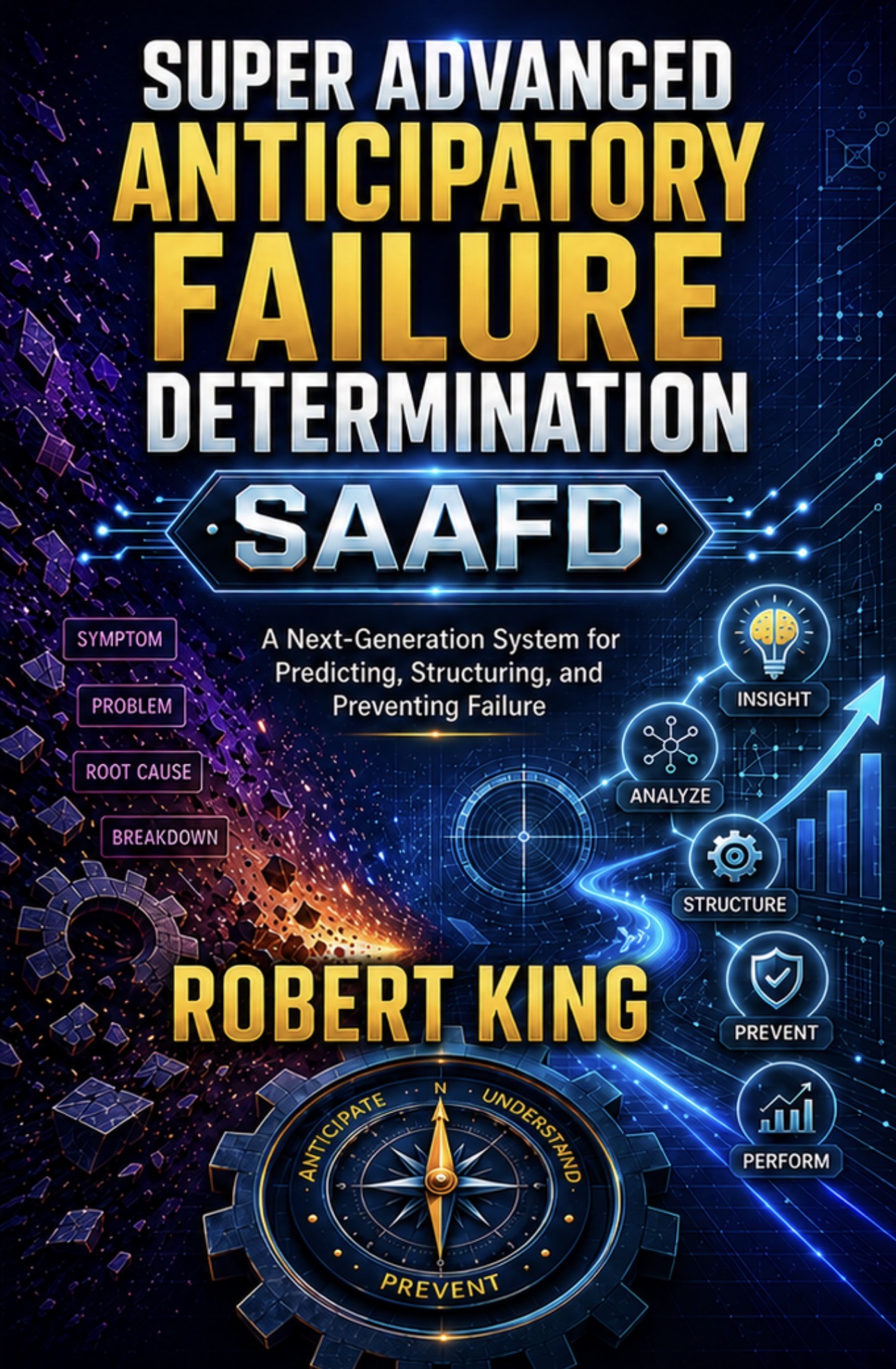
The foundational book
Discover the thinking behind Super Advanced Anticipatory Failure Determination by Robert King. The book introduces the philosophy, method, and practical questioning approach that help people move from reactive problem solving toward stronger failure prevention.
Official book cover shown. For current ordering and availability information, contact SAAFD.
Learn the methodology
SAAFD training is being designed to help individuals, facilitators, and organizations apply the method—not merely learn its terminology.
We are developing core instruction, deeper application workshops, and materials that connect the book to real-world team practice.
A structured introduction to the six phases and supporting quality tools.
More complex investigations, proof strategies, and stronger prevention design.
Facilitator guidance, participant exercises, and workplace application support.
Programs to build alignment around investigation quality and system learning.
Built for real-world decisions
Wherever failures arise from interacting people, processes, technologies, controls, and decisions, deeper investigation can improve outcomes.
Start the conversation
Ask about the book, upcoming training, organization briefings, or how SAAFD can support stronger investigations.